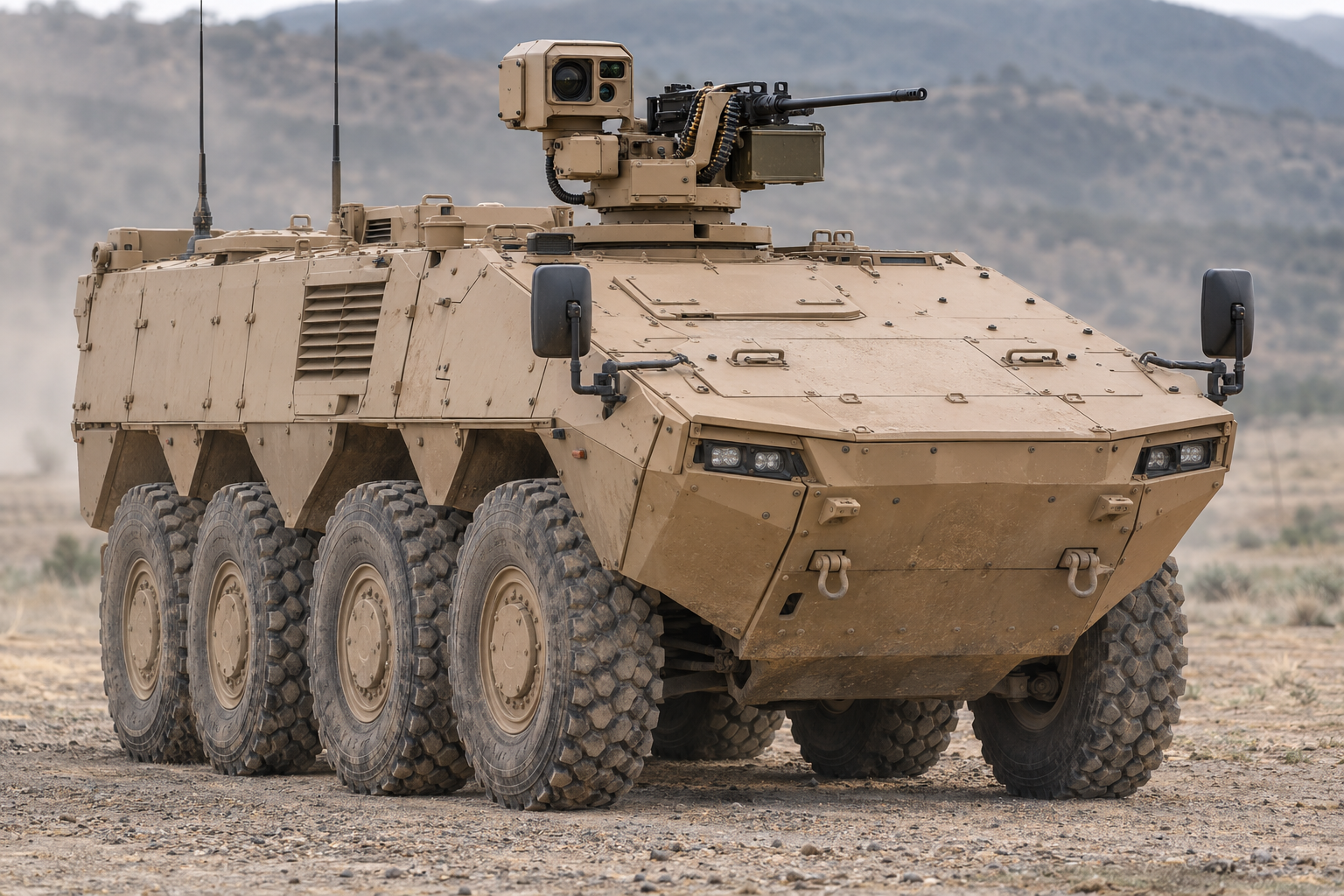
In short: Rafael’s Samson remote controlled weapon station lets a crew aim and fire a machine gun, grenade launcher or cannon from a screen inside the armored vehicle. The gunner stays under armor and the sensors do the looking. The trade-off is a narrower view of the world, which crews have to train around.
For most of the 20th century, the machine gun on an armored vehicle came with a person attached. Someone had to stand in an open hatch, head and shoulders exposed, to aim it. That person was often the first casualty in an ambush. Remote weapon stations removed the person from the hatch, and Samson, known in Hebrew as Katlanit, is one of the most widely exported examples.
Read also: The smartest part of a SPICE bomb is that it does not need the satellites · Spike is sold as fire-and-forget. Its real edge is that the gunner doesn’t have to forget · A modern tank survives the RPG by deciding, not by absorbing
What a remote weapon station actually is
A remote weapon station is a stabilized mount on the roof of a vehicle. It carries a weapon, a day camera, a thermal camera and usually a laser rangefinder. The operator sits below, watches a monitor and uses a hand controller. When the gun fires, nobody is outside.
Stabilization is the quiet advantage. A gunner standing in a moving hatch is bouncing with the suspension. A stabilized mount keeps the sight on target while the vehicle drives over rough ground, so the crew can engage on the move instead of stopping first.
One family, very different weights
Rafael built Samson as a family rather than a single product. The smallest version fits a light patrol vehicle. The largest turns an armored personnel carrier into something close to an infantry fighting vehicle.
The 30 mm version can also carry an optional launcher for the Spike guided missile, plus smoke grenades. That combination gives a wheeled vehicle a real anti-armor punch without adding a manned turret.
Where Samson shows up
The station has been fitted to vehicles such as the Polish Rosomak and the Czech Pandur II. Israel has also mounted variants in fixed positions along the Gaza border fence, where operators in a rear base control the weapon through cameras. That last use shows the core idea in its purest form: the sensor and the shooter are in different places.
The same logic runs through the rest of modern vehicle protection. A tank fitted with an active protection system survives because it decides rather than absorbs, and a remote station keeps the crew alive by keeping them out of the line of fire altogether.
The cost of fighting through a screen
Remote stations solve one problem and create another. A gunner in an open hatch could hear gunfire, smell smoke and turn their head in a second. On a monitor, the field of view is whatever the camera points at.
- Situational awareness drops, especially in dense urban streets with threats from above.
- A heavy mount raises the vehicle’s center of gravity, which matters on slopes.
- Cameras and optics need cleaning and maintenance in dust and mud.
- If power or electronics fail, the weapon becomes much harder to use.
Armies handle this with extra cameras around the hull, crew training and sometimes a secondary hatch-mounted gun. None of it changes the basic rule that the weapon is the last step in a chain that starts with seeing the threat.
Technical background, variants and operators are listed in the Samson RCWS entry on Wikipedia.
When you read about a new armored vehicle purchase, check two things before judging it: what sits on the roof, and how many cameras feed the crew below. Those two details tell you more about how it will fight than its top speed.
More articles you may like
- The smartest part of a SPICE bomb is that it does not need the satellites
- Spike is sold as fire-and-forget. Its real edge is that the gunner doesn’t have to forget
- A modern tank survives the RPG by deciding, not by absorbing
- The quietest air defense layer fires nothing at all
- Air defense at sea is not the same system bolted onto a ship
- Arrow 3 does its job in space, not in the sky above you