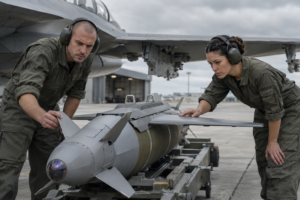




The smartest part of a SPICE bomb is that it does not need the satellites
In short: SPICE is a Rafael guidance kit that turns a standard unguided bomb into a precision weapon. Its edge over GPS-only kits is an electro-optical seeker that can find…
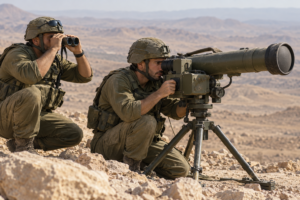
Spike is sold as fire-and-forget. Its real edge is that the gunner doesn’t have to forget
In short: Rafael’s Spike anti-tank missile can lock on before launch and guide itself, but its longer-range versions trail a fiber-optic cable back to the operator. That link lets the…
A modern tank survives the RPG by deciding, not by absorbing
In short: active protection systems detect an incoming rocket with radar and fire a countermeasure at it in a few milliseconds, before it reaches the hull. Steel still matters, but…
The quietest air defense layer fires nothing at all
In short: a large share of drone defeats never involve an interceptor. Electronic warfare attacks the link and the navigation signal instead of the airframe, costs almost nothing per engagement,…
Air defense at sea is not the same system bolted onto a ship
In short: a warship defends itself under conditions a land battery never faces, including a moving launch platform, a magazine it cannot reload at sea, and a radar horizon that…
Arrow 3 does its job in space, not in the sky above you
In short: most people picture Arrow 3 as a taller Iron Dome that reaches higher. It is not. Arrow 3 leaves the atmosphere and destroys a warhead in space, hundreds…
David’s Sling is not a bigger Iron Dome, it answers a different threat
In short: David’s Sling covers the gap between short-range rockets and long-range ballistic missiles, hitting cruise missiles, aircraft and large rockets at ranges Iron Dome was never built for. It…
Why stopping a cheap drone is harder than stopping a missile
In short: a small drone is slow, low and quiet, which sounds easy to counter but actually defeats systems built for fast, high-flying threats. Radar struggles to separate a plastic…
The missile is the last step, not the first
In short: an air-defense engagement is a fixed sequence of steps, not a single shot. Sensors detect a target, a computer builds a track and identifies it, an operator or…
The interceptor does not win the engagement. The radar does.
In short: Interceptors get the glory, but the radar network decides the fight. Sensors detect, classify, and track a threat, then hand a fire-control quality track to the launcher. No…