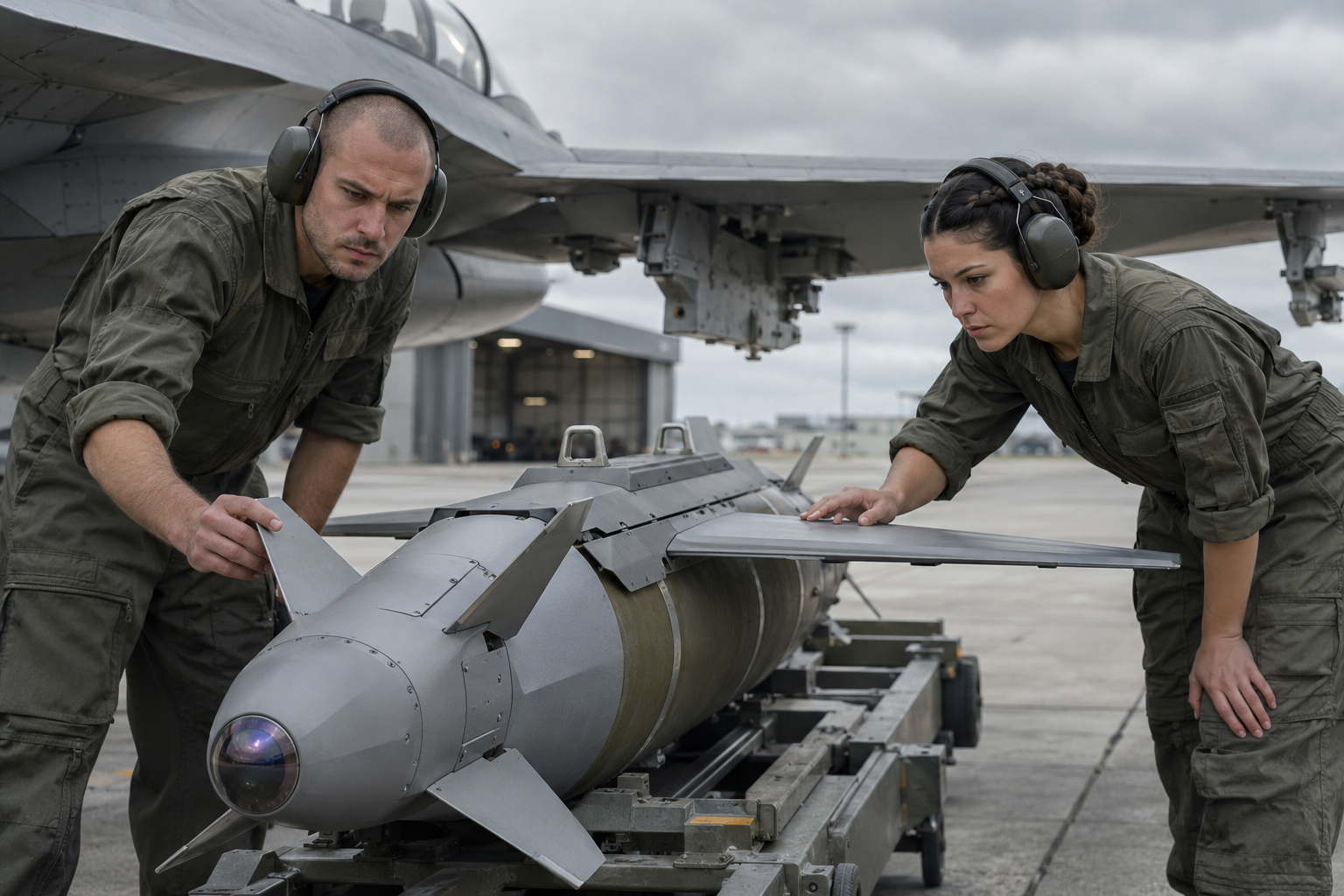
In short: SPICE is a Rafael guidance kit that turns a standard unguided bomb into a precision weapon. Its edge over GPS-only kits is an electro-optical seeker that can find the target by sight, so jamming or a moving target does not end the mission.
Most people picture a precision bomb as a GPS receiver with fins. Feed it coordinates, drop it, and the satellites do the rest. That model works well until someone jams the signal or the target is not where the coordinates say it is.
Read also: Spike is sold as fire-and-forget. Its real edge is that the gunner doesn’t have to forget · A modern tank survives the RPG by deciding, not by absorbing · The quietest air defense layer fires nothing at all
The Israeli SPICE family was built around exactly that gap.
A kit, not a new bomb
SPICE stands for “Smart, Precise Impact, Cost-Effective”, and the last two words explain the business case. Rafael does not sell a new weapon body. It sells a nose and tail section that bolts onto bombs air forces already have in storage, such as the Mk 83 and Mk 84. The guidance heritage comes from the Popeye air-to-surface missile, and the kit reached initial operational capability with Israeli Air Force F-16 squadrons in 2003.
There are three main sizes, matched to bomb weight:
Two ways to find the target
The kit combines satellite navigation with an electro-optical seeker. GPS gets the bomb to the right area in any weather. The camera then compares what it sees with reference imagery loaded before the flight and locks onto the actual target. Published figures put accuracy at about 3 meters CEP.
That second channel matters for two reasons. It keeps working when satellite signals are degraded, and it can handle relocatable targets that GPS coordinates would miss. The weapon also supports a man-in-the-loop mode, where an operator can refine the aim during the final phase. The same philosophy runs through Rafael’s Spike missile family: automation by default, a human hand available when it counts.
Range without a rocket motor
SPICE has no engine. It glides. Twelve control surfaces in three groups along the body give it a glide range of roughly 60 kilometers, according to open sources. A pilot can release it well outside the reach of most short and medium range air defense systems, which is the same stand-off logic that shapes the missile is the last step thinking on the defensive side.
Gliding instead of flying under power keeps the unit price far below that of a cruise missile. In an era when stopping a cheap drone can cost more than the drone itself, cost per effect has to be designed in from the first sketch.
Who uses it and what is on record
The open record lists the Israeli Air Force, the Indian Air Force and the Hellenic Air Force as operators. The kit has been integrated on aircraft including the F-15, F-16, Mirage 2000 and Su-30MKI. In February 2019 the Indian Air Force stated that its Mirage 2000 jets used SPICE 2000 munitions in the Balakot strike. Pakistan disputed the reported damage, a reminder that official claims about strike results deserve independent verification.
Key capabilities, as described in public sources:
- Up to 100 targets can be stored before take-off and selected in flight.
- Multiple bombs can be released at different targets in a single pass.
- Works day or night and through bad weather.
- Electro-optical homing reduces dependence on external satellite signals.
- Glide range lets the launch aircraft stay outside many defensive envelopes.
The technical summary and its sources are collected on Wikipedia’s Spice (bomb) entry.
How to read the next headline
When a news report says a strike used “GPS-guided bombs”, check which kit was involved before drawing conclusions about jamming or accuracy. A GPS-only weapon and a SPICE-type weapon fail in different ways, and the difference tells you far more about the operation than the explosive weight does.
More articles you may like
- Spike is sold as fire-and-forget. Its real edge is that the gunner doesn’t have to forget
- A modern tank survives the RPG by deciding, not by absorbing
- The quietest air defense layer fires nothing at all
- Air defense at sea is not the same system bolted onto a ship
- Arrow 3 does its job in space, not in the sky above you
- David’s Sling is not a bigger Iron Dome, it answers a different threat