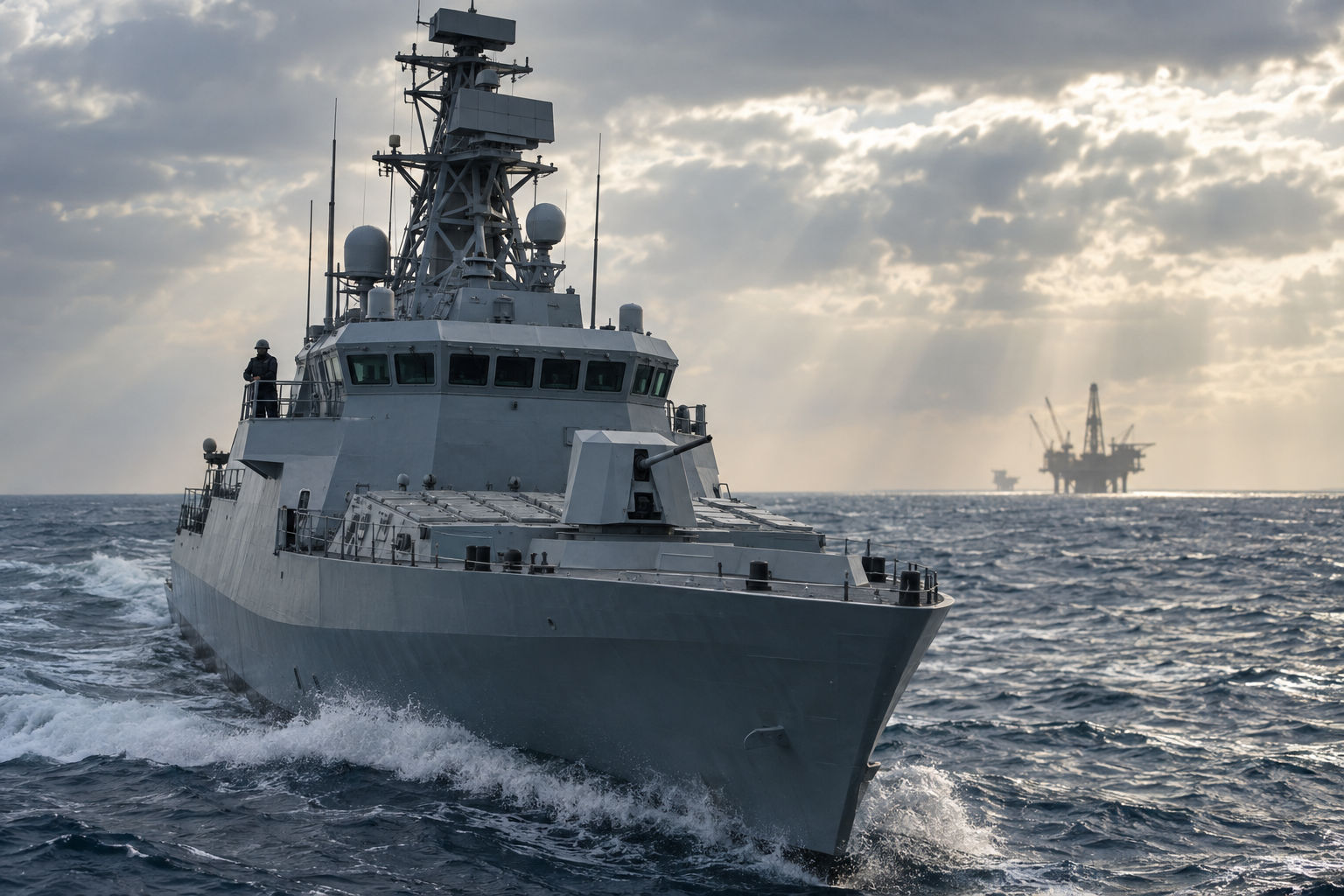
In short: a warship defends itself under conditions a land battery never faces, including a moving launch platform, a magazine it cannot reload at sea, and a radar horizon that hides sea-skimming missiles until the last seconds. Naval versions of Iron Dome and Barak exist because the engagement geometry changes, not because the hardware needed a coat of paint.
The common reading of naval air defense treats a ship as a mobile battery. Put the launcher on the deck, put the radar on the mast, and the problem is solved. That picture falls apart on the first detail: the ship is both the sensor and the target, and it has one chance to get the sequence right.
קראו גם: Arrow 3 does its job in space, not in the sky above you · David’s Sling is not a bigger Iron Dome, it answers a different threat · Why stopping a cheap drone is harder than stopping a missile
The horizon decides the timeline
A radar mounted 20 meters above the waterline sees a low flying object only when it crosses the geometric limit set by the curvature of the earth. Against an anti-ship missile flying a few meters above the waves at close to the speed of sound, that limit can leave under 30 seconds between detection and impact. A land battery defending a city usually works with minutes.
This is why naval systems lean on high mounted or off-board sensors: aircraft, helicopters, drones, or data from another ship. The same logic that makes detection the hard part on land applies here with less margin, and it is the reason the radar rather than the interceptor decides the engagement.
A magazine you cannot refill
A land battery is resupplied by truck. A corvette carries what it carries. Every vertical launch cell spent is gone until the ship reaches port, so the fire control logic has to be stingy in a way no ground commander needs to be.
That constraint shapes doctrine. Cheap saturation attacks are attractive against ships precisely because the defender runs out first, the same economic problem described in why a cheap drone is harder to stop than a missile. Guns and electronic warfare exist on modern ships as the answer to the last few hundred meters, and to conserve interceptors.
Land versus sea, side by side
The last row is the one that drives procurement. A single hit on a ship removes the sensor, the launcher, and the crew at once. Redundancy has to live inside one hull.
Stabilization is a real engineering problem
A ship rolls. Pointing a radar beam and launching an interceptor from a deck that moves in three axes requires continuous compensation, fed by inertial navigation and satellite positioning. Errors of a fraction of a degree translate into hundreds of meters at intercept range.
Vertical launch helps. The missile leaves the cell straight up and turns toward the target after it clears the ship, which removes the need for a trainable launcher and keeps the deck free. It also means the interceptor spends energy on that turn, shortening its reach against close targets.
What Israel actually fields
The Israeli Navy operates four Sa’ar 6-class corvettes, delivered from Germany and fitted out in Israel. They carry C-Dome, the naval version of the Tamir interceptor family, alongside Barak 8 for longer ranges. C-Dome uses the ship’s own radar instead of a dedicated battery radar, which is the main departure from the way the land based Iron Dome battery is organized.
Their standing task goes beyond self defense. The gas platforms off the Israeli coast are fixed, unarmed, and economically central, so a ship on station becomes the air defense of a structure that cannot defend itself.
What to watch when reading naval defense claims
- Stated intercept range means little without the altitude of the incoming threat and the height of the sensor.
- Cell count matters more than interceptor performance in a saturation scenario.
- Any claim of layered defense should name the inner layer, usually a gun or a jammer, not only the missile.
- Test results at sea are recorded against known targets on scheduled dates, which is the easiest version of the problem.
- Coverage of a fixed asset such as a rig depends on where the ship is allowed to sit, not on the radar alone.
Next time a naval intercept is announced, look for the detection range and the sensor that provided it. That number, not the missile name, tells you how much time the crew actually had.
מאמרים נוספים שיעניינו אתכם
- Arrow 3 does its job in space, not in the sky above you
- David’s Sling is not a bigger Iron Dome, it answers a different threat
- Why stopping a cheap drone is harder than stopping a missile
- The missile is the last step, not the first
- The interceptor does not win the engagement. The radar does.
- A laser will not empty the sky of every threat