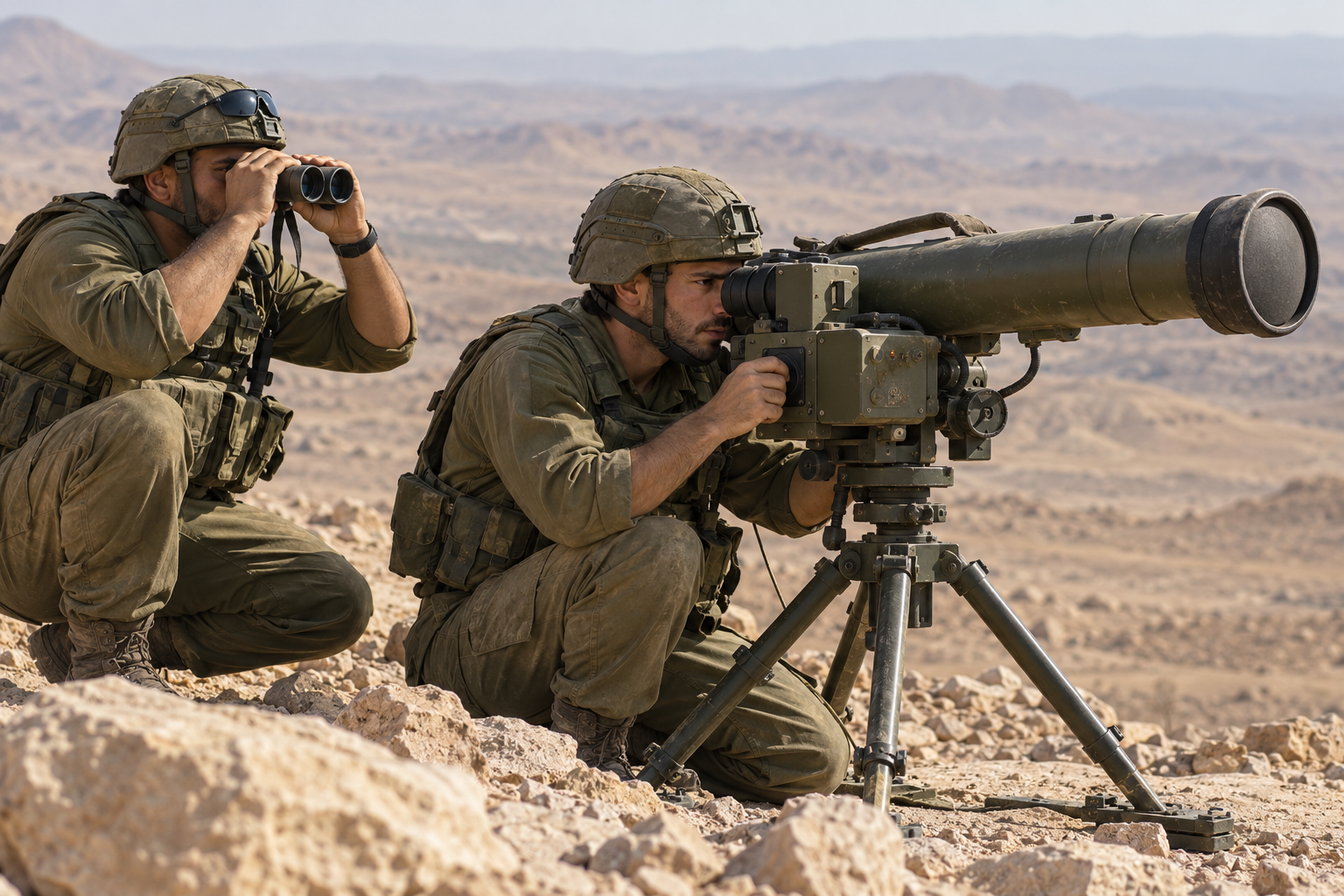
In short: Rafael’s Spike anti-tank missile can lock on before launch and guide itself, but its longer-range versions trail a fiber-optic cable back to the operator. That link lets the gunner pick a target after launch, switch targets mid-flight, or abort. The feature matters more than the warhead.
The standard description of Spike is “fire-and-forget.” Lock the seeker on a tank, pull the trigger, take cover. That’s accurate for the short-range models. It misses what made the family sell to more than 40 countries.
Read also: A modern tank survives the RPG by deciding, not by absorbing · The quietest air defense layer fires nothing at all · Air defense at sea is not the same system bolted onto a ship
The longer-range Spikes are built around the opposite idea.
A cable thinner than a hair
Spike LR and ER missiles unspool a fiber-optic wire behind them as they fly. Video from the missile’s imaging infrared seeker travels back down that wire to the launcher, and steering commands travel forward. Rafael calls the mode “fire, observe and update.” Engineers call it lock-on after launch.
In practice, the gunner can launch at a hillside where a vehicle was last seen, watch the picture as the missile climbs, then choose the target once it’s actually visible. If a better target appears, they can switch. If civilians wander into frame, they can steer away.
A radio link can be jammed. A fiber can’t, short of cutting it. That’s the same logic behind the observation that the missile is the last step in a long chain of sensing and deciding, and Spike simply stretches that chain into the flight itself.
One family, very different jobs
Spike is less a single missile than a ladder of them. Ranges below come from published Rafael and EuroSpike figures:
The short-range SR has no wire at all. It was introduced in 2012 to give a platoon a guided round between the MR and unguided rockets, and its cheap uncooled seeker doubles as the sight.
Why the top-attack angle matters now
Tanks increasingly carry active protection, radars and launchers that shoot down incoming rounds. That’s the system described in a modern tank survives the RPG by deciding rather than by soaking up the hit. Spike LR2 answered with a counter-APS design and the ability to strike at impact angles up to 70 degrees, diving onto the thinner roof armor.
Other details aimed at the same problem:
- A tandem warhead: a small precursor charge sets off explosive reactive armor, the main charge then penetrates
- Soft launch, with the motor igniting after the missile clears the tube, so it can be fired from inside a room
- Grid-coordinate engagement, letting a drone or forward observer hand off targets the gunner can’t see
- An AI-assisted tracker in the LR2 seeker that holds a target through clutter
The cost question
A Spike LR cost the German army about $140,000 per round in 2017. A Spike NLOS for the US Army ran close to $250,000 in 2022. Those prices only make sense against expensive targets, which is the same arithmetic that explains why stopping a cheap drone is harder than stopping a missile.
Rafael says it had delivered over 40,000 Spikes by 2023, and roughly 7,000 were fired in tests, training and combat. Specifications and operator lists are collected on the Spike (missile) Wikipedia entry.
When you next read “fire-and-forget” in a procurement story, check which variant is being bought. If it’s LR, ER or NLOS, ask how long the link is. That number tells you how much judgment the gunner keeps after pulling the trigger.
More articles you may like
- A modern tank survives the RPG by deciding, not by absorbing
- The quietest air defense layer fires nothing at all
- Air defense at sea is not the same system bolted onto a ship
- Arrow 3 does its job in space, not in the sky above you
- David’s Sling is not a bigger Iron Dome, it answers a different threat
- Why stopping a cheap drone is harder than stopping a missile